

Airport Robots Market Size to Surpass US$ 5.12 Billion by 2035, Expanding at a CAGR of 14.92% from 2025-2035
Airport Robots Market
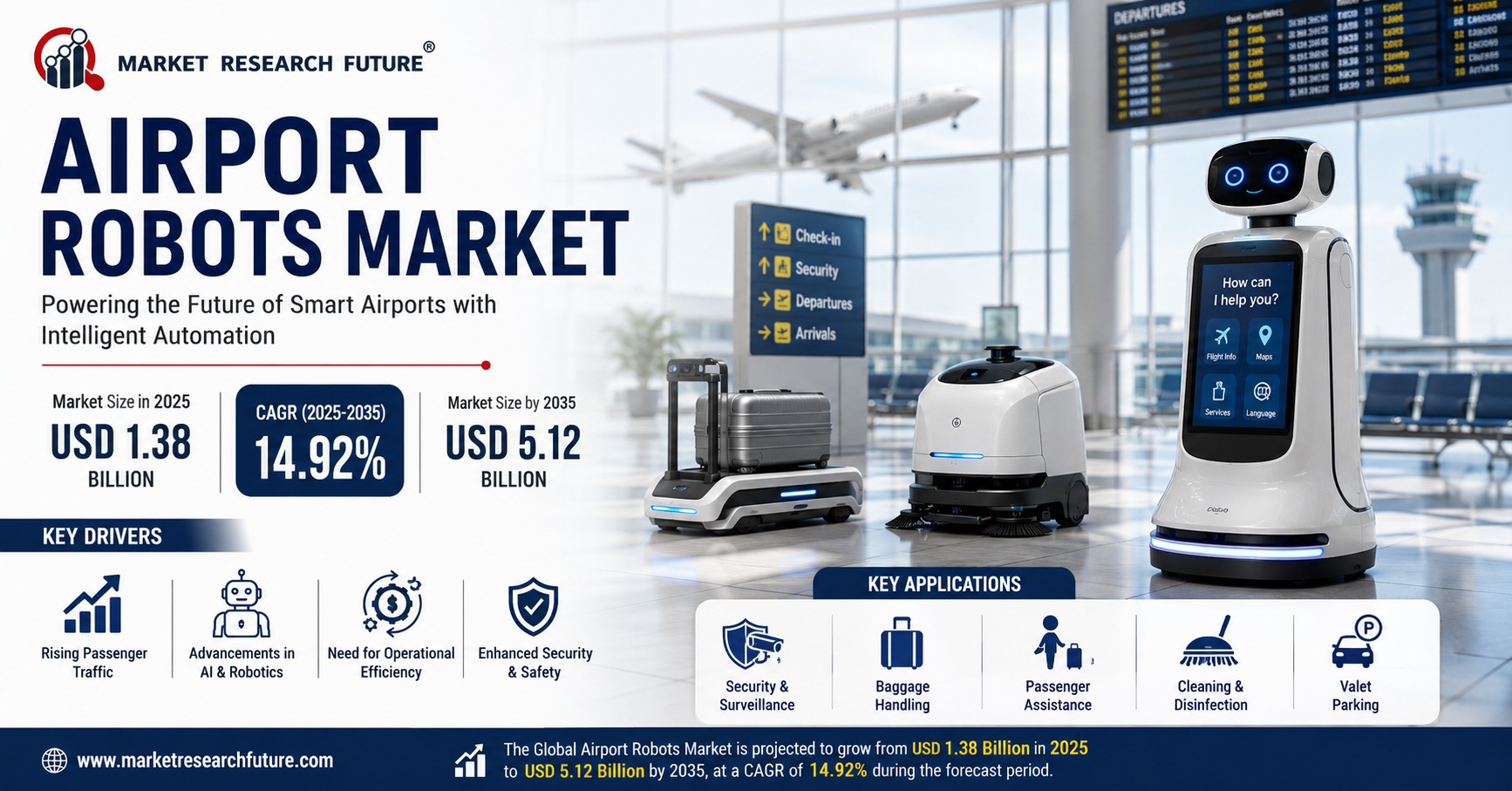
Global Airport Robots Market is witnessing significant momentum as airports across the world increasingly embrace automation technologies to improve operational efficiency, enhance passenger experiences, strengthen security measures, and address labor shortages. The market, valued at USD 1.38 billion in 2025, is projected to reach USD 5.12 billion by 2035, expanding at a CAGR of 14.92% during the forecast period from 2025 to 2035. The rapid adoption of artificial intelligence, machine learning, autonomous navigation systems, computer vision, and advanced sensor technologies is transforming airport operations and creating substantial opportunities for robotic solutions across terminal and landside applications.
Airport robots are becoming an integral component of modern aviation infrastructure. These intelligent systems are increasingly deployed for baggage handling, passenger assistance, security surveillance, valet parking, cleaning and disinfection, and operational logistics. As airports seek to accommodate growing passenger traffic while maintaining high service standards, robotic technologies are emerging as a critical enabler of operational excellence.
Market Overview
The airport industry is undergoing a profound digital transformation characterized by the integration of smart technologies designed to optimize efficiency and improve customer satisfaction. Airport robots represent one of the fastest-growing segments within the broader smart airport ecosystem.
The Airport Robots Market is expected to grow from USD 1.57 billion in 2026 to USD 5.12 billion by 2035. This growth is largely fueled by increasing passenger volumes, rising investment in airport modernization projects, and the growing demand for automated services that can operate continuously with minimal human intervention.
Robotic systems are increasingly being deployed to perform repetitive, labor-intensive, and mission-critical tasks that were traditionally handled by human workers. These solutions not only improve operational productivity but also contribute to cost savings, enhanced safety, and better passenger engagement.
Furthermore, advancements in autonomous mobility, natural language processing, artificial intelligence, and Internet of Things (IoT) connectivity are enabling airport robots to become more intelligent, responsive, and capable of performing increasingly complex tasks.
Request Sample PDF of Report: https://www.marketresearchfuture.com/sample_request/10563
Latest Trends Shaping the Airport Robots Market:
1. Growing Adoption of AI-Powered Passenger Assistance Robots
One of the most prominent trends in the Airport Robots Market is the increasing deployment of AI-enabled passenger assistance robots. These robots provide real-time information regarding flight schedules, gate changes, baggage claims, airport navigation, and customer support.
Advanced natural language processing capabilities enable these robots to communicate in multiple languages, helping airports serve diverse international travelers more effectively. As airports strive to improve passenger satisfaction and reduce waiting times, demand for intelligent service robots continues to grow.
2. Expansion of Autonomous Security and Surveillance Systems
Airport security remains a top priority for aviation authorities worldwide. Autonomous security robots equipped with AI-powered analytics, thermal imaging cameras, LiDAR sensors, and facial recognition technologies are increasingly being used to monitor terminals, runways, parking areas, and restricted zones.
These robotic solutions provide continuous surveillance capabilities while supporting human security personnel with enhanced situational awareness and threat detection.
3. Increased Focus on Cleaning and Disinfection Automation
The emphasis on hygiene and sanitation has significantly accelerated the deployment of robotic cleaning systems. Airports are investing in autonomous cleaning and disinfection robots capable of operating around the clock while maintaining high sanitation standards.
This trend is expected to remain strong as airport operators continue prioritizing passenger health and operational efficiency.
4. Integration of Computer Vision and LiDAR Technologies
Advanced sensor technologies are playing a crucial role in enhancing robot performance. Computer vision systems and LiDAR-based navigation enable robots to safely move through crowded airport environments while accurately identifying obstacles and optimizing routes.
The integration of these technologies is improving robot reliability and expanding their range of applications across airport operations.
5. Development of Smart Airport Ecosystems
Modern airports are increasingly adopting interconnected digital ecosystems where robots communicate seamlessly with airport management systems, security networks, baggage handling infrastructure, and passenger information platforms.
This integrated approach is enabling real-time decision-making, improved operational coordination, and enhanced service delivery.
Market Drivers:
1. Rising Passenger Traffic Worldwide
One of the primary factors driving market growth is the steady increase in global air passenger traffic. As airports handle larger volumes of travelers, there is growing pressure to improve efficiency without significantly expanding workforce requirements.
Robotic solutions help airports manage increasing passenger demand while maintaining high service standards and operational reliability. The ability of robots to operate continuously and perform repetitive tasks efficiently makes them particularly valuable in high-traffic airport environments.
2. Growing Airport Modernization Initiatives
Governments and airport authorities are investing heavily in airport modernization and smart infrastructure development. These initiatives often include the deployment of advanced robotic technologies designed to improve operational performance and passenger experience.
The transition toward digitally connected airports is creating substantial opportunities for robot manufacturers and technology providers.
3. Persistent Labor Shortages
Many airports face challenges related to workforce shortages and rising labor costs. Robotic systems offer a practical solution by automating routine activities such as cleaning, baggage transportation, security monitoring, and passenger assistance.
By reducing dependence on manual labor, airports can improve operational resilience while lowering long-term costs.
4. Increasing Focus on Operational Efficiency
Airport operators are under constant pressure to improve efficiency and reduce turnaround times. Robotic technologies contribute significantly to these objectives by automating workflows, minimizing errors, and improving resource utilization.
Enhanced operational efficiency translates directly into cost savings and improved passenger experiences, making robotic investments increasingly attractive.
5. Advances in Artificial Intelligence and Robotics
Rapid technological advancements are making airport robots more capable, reliable, and cost-effective. Improvements in machine learning, computer vision, navigation systems, and human-robot interaction technologies are expanding the range of applications for robotic solutions.
These innovations are accelerating adoption across airports of all sizes.
Emerging Opportunities:
1. Expansion of Humanoid Robot Deployments
Although non-humanoid robots currently dominate the market, humanoid robots are expected to experience strong growth during the forecast period. Humanoid robots offer enhanced interaction capabilities and can perform customer service functions more effectively in passenger-facing environments. Humanoid robots are projected to grow at a CAGR of 16.8% through 2035.
2. Smart Baggage Handling Automation
The increasing complexity of baggage management presents significant opportunities for robotic automation. Advanced baggage handling robots can improve accuracy, reduce delays, and enhance overall airport efficiency.
As passenger volumes continue to rise, demand for automated baggage solutions is expected to increase substantially.
3. Autonomous Valet Parking Services
Landside airport operations are emerging as a promising growth area. Autonomous valet parking systems can maximize parking space utilization while improving convenience for travelers.
The growing adoption of autonomous vehicle technologies is expected to support the expansion of robotic valet parking solutions.
4. Growth of Regional and Emerging Airports
Developing economies are investing heavily in airport infrastructure expansion. New airports and regional aviation hubs are increasingly incorporating robotic technologies during the planning and development phases.
This trend presents significant opportunities for market participants seeking geographic expansion.
5. Data-Driven Airport Operations
Airport robots generate valuable operational data that can be used to optimize processes, improve resource allocation, and enhance passenger experiences. The growing importance of data analytics is creating new opportunities for integrated robotic and software solutions.
Segment Analysis;
1. By Application
Terminal Segment - The terminal segment dominated the Airport Robots Market in 2025, accounting for approximately 73% of total market revenue. Terminal robots are widely used for passenger guidance, customer service, information dissemination, security monitoring, and cleaning operations.
The increasing emphasis on passenger experience and operational efficiency continues to drive demand for terminal-based robotic solutions.
Landside Segment - The landside segment is expected to witness substantial growth throughout the forecast period. Applications include autonomous valet parking, curbside logistics, transportation assistance, and parking management.
The segment is forecast to grow at a CAGR of 15.6% through 2035 as sensor technologies and autonomous navigation capabilities continue to improve.
2. By Robot Type
Non-Humanoid Robots - Non-humanoid robots held the largest market share in 2025 and were valued at approximately USD 1.04 billion. These robots are widely utilized for cleaning, surveillance, logistics, baggage handling, and disinfection tasks.
Their lower cost, ease of deployment, and operational efficiency make them the preferred choice for many airport applications.
Humanoid Robots - Humanoid robots represent an emerging growth segment characterized by advanced communication and interaction capabilities. These robots are increasingly used for passenger engagement, customer support, and multilingual assistance.
As AI technologies continue to evolve, humanoid robots are expected to play a larger role in airport operations.
3. By End Use
Airport Security - Airport security emerged as the leading end-use segment, accounting for approximately 34.2% of market share in 2025. Security robots provide surveillance, threat detection, perimeter monitoring, and real-time incident reporting capabilities.
The growing focus on aviation security and public safety continues to drive investment in robotic security solutions.
Baggage Handling - Automated baggage handling robots improve operational efficiency by reducing processing times and minimizing errors. These systems are becoming increasingly important as passenger volumes grow.
Cleaning and Disinfection - Cleaning and disinfection robots are projected to register the fastest growth rate among end-use categories, expanding at a CAGR of 17.4% through 2035. Their ability to maintain hygiene standards while reducing labor requirements makes them highly attractive to airport operators.
Passenger Service and Guidance - Passenger assistance robots support travelers through navigation, information services, language translation, and personalized assistance. This segment continues to gain traction as airports focus on customer experience enhancement.
Valet Parking - Autonomous parking robots streamline vehicle storage and retrieval processes, improving space utilization and operational efficiency.
Regional Analysis;
North America - North America held the largest share of the Airport Robots Market in 2025, accounting for approximately USD 0.48 billion in revenue and around 34.5% of the global market.
The region benefits from advanced airport infrastructure, strong technology adoption, substantial government support for innovation, and increasing investments in airport modernization. The United States remains the dominant contributor to regional growth.
Europe - Europe represents the second-largest regional market. The region's growth is supported by ongoing airport digitization initiatives, increasing adoption of smart airport technologies, and significant investments in automation.
European airports continue to focus on operational sustainability, security enhancement, and passenger experience improvement, creating favorable conditions for robotic deployment.
Asia-Pacific - Asia-Pacific is projected to be the fastest-growing regional market, with an anticipated CAGR of 18.2% through 2035.
Rapid aviation expansion, increasing airport construction projects, and government-backed smart airport initiatives are driving strong demand across China, Japan, South Korea, and other emerging economies. The region's growing passenger base further supports market growth.
South America - South America is gradually adopting airport robotics technologies as airports modernize infrastructure and improve operational capabilities. Growing tourism and air travel demand are expected to support future market expansion.
Middle East & Africa - The Middle East & Africa region is witnessing increasing investments in advanced airport technologies, particularly in major international aviation hubs. The focus on creating world-class airport experiences is encouraging the adoption of innovative robotic solutions.
Top Companies Profiled in the Airport Robots Market:
SoftBank Robotics - SoftBank Robotics is a leading provider of service robots designed to improve customer engagement and operational efficiency. The company is recognized for its advanced humanoid robotics solutions widely used in public-facing environments.
LG Electronics - LG Electronics offers innovative robotic technologies focused on customer assistance, cleaning automation, and smart service applications. The company continues to expand its robotics portfolio for airport deployments.
ABB Ltd. - ABB Ltd. is a global leader in industrial automation and robotics. Its advanced robotic systems support operational optimization across multiple airport functions.
Stanley Robotics - Stanley Robotics specializes in autonomous valet parking solutions that enhance parking efficiency while improving customer convenience.
Knightscope Inc. - Knightscope develops autonomous security robots designed to strengthen surveillance capabilities and improve public safety within airport environments.
SITA - SITA provides technology solutions for the aviation industry and continues to advance airport automation through intelligent robotic platforms and digital infrastructure.
Vanderlande (Toyota Industries) - Vanderlande is a major provider of baggage handling automation systems and logistics technologies that support airport operational excellence.
ICM Airport Technics - ICM Airport Technics delivers specialized airport technology solutions aimed at improving efficiency, passenger flow, and operational performance.
Recent Developments:
June 2026: Several international airports expanded the deployment of autonomous service robots, including robotic wheelchairs, cleaning robots, waste-management systems, and passenger guidance solutions, demonstrating the industry's growing reliance on robotics to enhance accessibility and operational performance.
May 2026: Market participants intensified the integration of LiDAR, computer vision, and artificial intelligence technologies into airport robots, enabling improved autonomous navigation, security monitoring, and operational decision-making across airport environments.
April 2026: Japan Airlines announced a pilot program at Haneda Airport to deploy humanoid robots for baggage and cargo handling operations. The initiative aims to address labor shortages while improving ground-handling efficiency through advanced robotic automation.
Future Outlook:
The Airport Robots Market is positioned for sustained long-term growth as airports increasingly embrace automation to address operational challenges, enhance passenger experiences, and improve security capabilities. The convergence of artificial intelligence, robotics, IoT connectivity, and smart airport initiatives is expected to create significant opportunities for technology providers and airport operators alike.
Browse More Reports:
Airport Automation Market
https://www.marketresearchfuture.com/reports/airport-automation-market-21981
Advanced Airport Technologies Market
https://www.marketresearchfuture.com/reports/advanced-airport-technologies-market-28929
Airport 4.0 Market
https://www.marketresearchfuture.com/reports/airport-4-0-market-31574
Airport Biometrics Market
https://www.marketresearchfuture.com/reports/airport-biometrics-market-6003
Sagar Kadam
Market Research Future
+ +1 628-258-0071
sales@marketresearchfuture.com
Visit us on social media:
LinkedIn
Facebook
YouTube
X
Legal Disclaimer:
EIN Presswire provides this news content "as is" without warranty of any kind. We do not accept any responsibility or liability for the accuracy, content, images, videos, licenses, completeness, legality, or reliability of the information contained in this article. If you have any complaints or copyright issues related to this article, kindly contact the author above.
