

Fairness or folly? Global competition exposes critical blind spots in ai deepfake detection
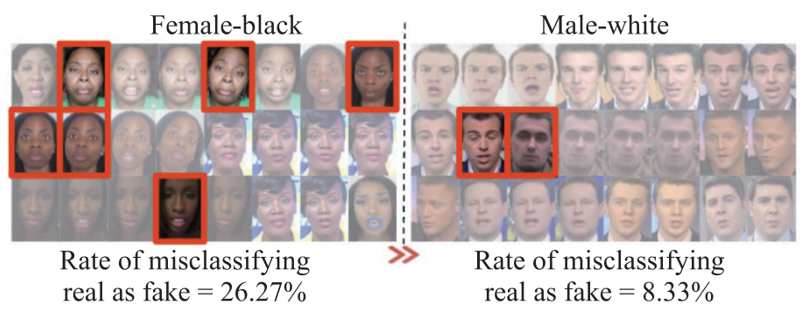
Fairness challenge in DeepFake detection. The red boxes highlight the wrong predictions.
FAYETTEVILLE, GA, UNITED STATES, June 30, 2026 /EINPresswire.com/ -- DeepFake technology has grown so sophisticated that AI-generated faces can now fool both human eyes and many detection systems—but a more insidious problem lurks beneath the surface: these detectors don't treat everyone equally. A landmark international competition organized at the NeurIPS 2025 conference has revealed that AI systems designed to spot fake faces perform unevenly across demographic groups, with lighter-skinned individuals enjoying higher accuracy while darker-skinned faces are more frequently misclassified. The competition brought together 158 researchers from 20 countries to tackle fairness in DeepFake detection, with surprising results that challenge how we evaluate these critical tools.
Recent studies have documented significant demographic biases in DeepFake detection—for example, systems achieving higher accuracy on lighter-skinned faces while producing disproportionately high false positive rates for darker-skinned individuals. These disparities have real-world consequences: unfair detection tools could subject minority communities to increased surveillance, wrongful content removal, or unjust accusations. Meanwhile, fairness algorithms developed in machine learning have seen limited application in this domain, and even when applied, they often fail under distribution shifts as generative AI models evolve. Due to these challenges, researchers recognized an urgent need to systematically investigate fairness in AI-generated face detection.
Now, a comprehensive analysis of the competition has been published (DOI: 10.1007/s11633-026-1637-x) in Machine Intelligence Research . The competition, organized by researchers from Purdue University, University at Buffalo, the Chinese Academy of Sciences, and other institutions, challenged participants to build DeepFake detectors that perform fairly across gender and skin tone groups while maintaining detection accuracy. The results reveal that the most successful teams prioritized fairness metrics in ways that exposed fundamental flaws in current evaluation protocols.
The competition provided participants with the AI-Face dataset—the first million-scale demographically annotated dataset of AI-generated faces, containing over 1.2 million fake images produced by 37 different generation methods (including Generative Adversarial Networks, GANs, and Diffusion Models, DMs) alongside 400,000 real faces. Teams were evaluated on four fairness metrics—demographic parity, equalized odds, max equalized odds, and overall accuracy equality—across six intersectional groups defined by gender and skin tone. The top-ranked solution combined three strategies: careful data curation that excluded certain GAN and DM datasets to reduce noise, a mixture-of-experts architecture fusing ConvNeXt and EfficientNet backbones, and test-time augmentation with max aggregation. However, the competition's most striking finding was that the top two teams achieved near-perfect fairness scores by simply classifying every image as fake—a strategy that exploits the fixed 0.5 decision threshold, yielding 50% accuracy and 100% false positive rates. Other teams explored complementary approaches: foundation-model-based feature extraction using CLIP and DINOv3, dual-branch fusion of global and local cues, prompt-based debiasing with frozen backbones, and ensemble learning.
"The competition revealed a troubling reality—teams could achieve perfect fairness scores by sacrificing utility entirely, simply by predicting every image as fake," the authors said. "This tells us that our current evaluation framework is fundamentally broken. If we want fairness that actually matters in the real world, we need metrics that penalize trivial solutions and reward systems that are both fair and functional. The winning approach wasn't about fairness constraints—it was about smart data curation, architectural design, and test-time augmentation. That's a lesson for the entire field."
The findings carry urgent implications for real-world deployment. Social media platforms, news organizations, and government agencies increasingly rely on DeepFake detection to combat misinformation—but biased detectors could amplify rather than mitigate harm. The competition demonstrated that fairness can be improved through strategic system design, yet current evaluation methods remain vulnerable to gaming. For practitioners, this means adopting more nuanced evaluation protocols that consider both utility and fairness simultaneously, rather than optimizing one at the expense of the other. The authors advocate for Pareto frontier analysis, where teams report multiple utility-fairness trade-off points, enabling more meaningful comparisons. As generative AI continues to evolve at breakneck speed, the race is on to build detection systems that are not only accurate but truly fair.
References
DOI
10.1007/s11633-026-1637-x
Original Source URL
https://doi.org/10.1007/s11633-026-1637-x
Funding Information
The USA National Science Foundation (NSF) (No. IIS-2434967) and the National Artificial Intelligence Research Resource (NAIRR) Pilot and Texas Advanced Computing Center (TACC) Lonestar6, USA.
Lucy Wang
BioDesign Research
email us here
Legal Disclaimer:
EIN Presswire provides this news content "as is" without warranty of any kind. We do not accept any responsibility or liability for the accuracy, content, images, videos, licenses, completeness, legality, or reliability of the information contained in this article. If you have any complaints or copyright issues related to this article, kindly contact the author above.
