

Latest Space-Based Missile Defense Interceptor System Market Research: Future Industry Trends and Forecasts
Space-Based Missile Defense Interceptor System Market Share

The Business Research Company
The Business Research Company’s Space-Based Missile Defense Interceptor System Global Market Report 2026 – Market Size, Trends, And Forecast 2026-2035
LONDON, GREATER LONDON, UNITED KINGDOM, September 14, 2026 /EINPresswire.com/ -- The global focus on advancing missile defense capabilities through space-based technologies has gained significant traction as nations seek enhanced security measures. This shift has driven growth in the space-based missile defense interceptor system market, which plays a crucial role in detecting and neutralizing missile threats from orbit. Let’s explore the current market size, growth factors, key players, and regional dynamics shaping this important defense sector.
Current Market Size and Expected Growth Trajectory for Space-Based Missile Defense Interceptor Systems
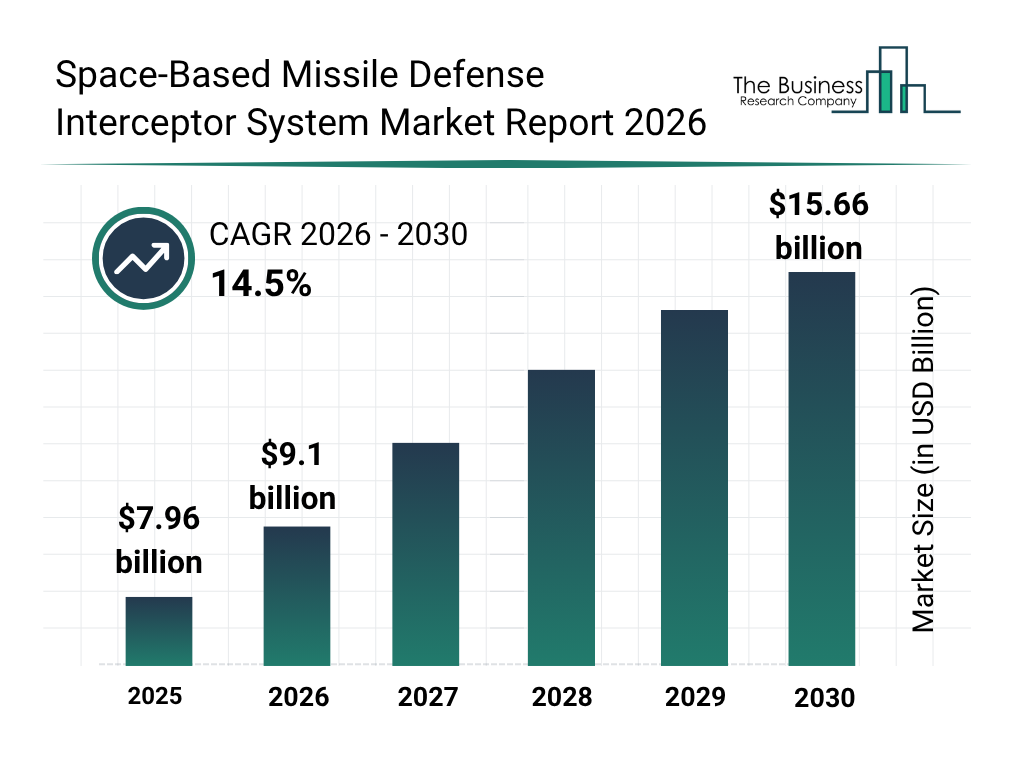
The market for space-based missile defense interceptor systems has experienced rapid growth in recent years. It is projected to increase from $7.96 billion in 2025 to $9.1 billion in 2026, reflecting a strong compound annual growth rate (CAGR) of 14.3%. Historically, this expansion has been driven by Cold War-era missile defense modernization programs, improvements in early warning radar and satellite surveillance technologies, rising ballistic missile threats, and ongoing investments in strategic deterrence and space sensor advancements.
Download a free sample of the space-based missile defense interceptor system market report:
https://thebusinessresearchcompany.com/sample_request?id=45253331&type=smp&name=Space-Based%20Missile%20Defense%20Interceptor%20System%20Market%20Report%202026&utm_source=EINPresswire&utm_medium=Paid&utm_campaign=Sep_PR
Looking ahead, the market is anticipated to accelerate further, reaching $15.66 billion by 2030 with a CAGR of 14.5%. This surge is fueled by the growing threat posed by hypersonic missiles worldwide, the intensification of space militarization initiatives, and a broad adoption of autonomous defense technologies. Additional contributors include the integration of AI-powered command and control systems and increased spending on multi-domain defense architectures. Noteworthy trends in this period encompass AI-enabled autonomous interception and target identification, space-based networks for detecting hypersonic threats, layered satellite defense systems offering worldwide missile coverage, cloud-based real-time command and control platforms, and enhanced predictive analytics for missile trajectory forecasting.
Understanding Space-Based Missile Defense Interceptor Systems
A space-based missile defense interceptor system is essentially a defense platform positioned in orbit with the objective of detecting, tracking, intercepting, and neutralizing incoming missile threats such as ballistic and hypersonic missiles before they can strike their intended targets. These systems rely on an array of space sensors, satellites, interceptor vehicles, and sophisticated command-and-control technologies to deliver early warning, global surveillance, and rapid response interception capabilities critical to modern missile defense strategies.
View the full space-based missile defense interceptor system market report:
https://www.thebusinessresearchcompany.com/report/space-based-missile-defense-interceptor-system-market-report?utm_source=EINPresswire&utm_medium=Paid&utm_campaign=Sep_PR
Primary Growth Drivers for the Space-Based Missile Defense Interceptor System Market
One of the main factors propelling this market is the continuous increase in defense budgets and national security modernization initiatives worldwide. Governments are allocating substantial resources to maintain and upgrade their military readiness in response to rising geopolitical tensions and evolving security threats. Investment in advanced defense technologies, including space-based interceptor systems, is a key component of these modernization efforts as they enhance national security through early threat detection and missile interception. For example, in April 2024, the Stockholm International Peace Research Institute (SIPRI) reported that global military expenditures reached $2.443 trillion in 2023, marking a 6.8% real-term growth compared to the previous year. This trend underscores the significant financial commitment fueling the market’s expansion.
Growth Boosted by Rising Satellite Launches and Demand for Space-Based Surveillance
Another critical element supporting market growth is the increasing frequency of satellite launches driven by the need for enhanced space-based defense surveillance and threat detection. Satellite launches involve deploying spacecraft into orbit for purposes ranging from communications to national security. Governments and defense agencies are heavily investing in expansive low Earth orbit (LEO) satellite constellations to improve real-time situational awareness and minimize exposure to missile attacks. Space-based missile defense systems also play a protective role, safeguarding satellites and launch vehicles from missile threats during both launch and operational phases. Data from the Space Foundation in January 2024 highlights this trend, noting record global launch activity for the third straight year, with 223 launch attempts and 212 successes. Commercial satellite launches rose by 50% compared to 2022, while the U.S. alone increased launch attempts by 33%, illustrating the growing momentum behind space-based defense technologies.
Dominant Regional Markets for Space-Based Missile Defense Interceptor Systems
In 2025, North America held the largest share of the space-based missile defense interceptor system market, cementing its leadership position in this sector. Meanwhile, the Asia-Pacific region is forecast to be the fastest-growing market during the coming years due to expanding defense investments and space program development. The market analysis spans several key regions including Asia-Pacific, South East Asia, Western Europe, Eastern Europe, North America, South America, the Middle East, and Africa, providing a broad perspective on the global competitive landscape and growth opportunities.
Our latest 2026 market reports provide expanded strategic and visual intelligence with market attractiveness scoring and analysis, total addressable market (TAM) analysis, company scoring matrix graphics and tables, Excel-based forecasting dashboards, market hotspots infographics, key technologies and future trend analysis, together with updated graphics and tables.
Speak With Our Expert:
Saumya Sahay
Americas +1 310-496-7795
Asia +44 7882 955267 & +91 8897263534
Europe +44 7882 955267
Email: marketing@tbrc.info
The Business Research Company - www.thebusinessresearchcompany.com
Follow Us On:
• LinkedIn: https://in.linkedin.com/company/the-business-research-company
Oliver Guirdham
The Business Research Company
+ +44 7882 955267
email us here
Visit us on social media:
LinkedIn
Facebook
X
Legal Disclaimer:
EIN Presswire provides this news content "as is" without warranty of any kind. We do not accept any responsibility or liability for the accuracy, content, images, videos, licenses, completeness, legality, or reliability of the information contained in this article. If you have any complaints or copyright issues related to this article, kindly contact the author above.
